
Lingual by Issembert
Lingual braces in Paris
Braces bonded behind your teeth: nobody sees them, and they treat every type of case — including extractions and surgery.
In brief
- How it works: brackets bonded to the inner surface of the teeth, on the tongue side — invisible from the front, as effective as conventional braces.
- For whom: mostly adults, but also many children and teenagers who want an invisible treatment.
- Speed: teeth are pre-aligned in 4 to 6 months; the rest of the treatment refines alignment, closes spaces and coordinates the arches.
- Options: “lingual-mixed” (lingual on top, ceramic hidden by the lower lip at the bottom) costs less. Double retention is always included.
Why choose lingual braces?
- They are completely invisible. Only you know you are wearing braces — essential in both your private and professional life.
- Your smile stays intact even with extractions. Temporary veneers can fill extraction spaces during treatment.
- Fast pre-alignment. Teeth line up in 4 to 6 months, so you enjoy the first changes early; the remaining time perfects the alignment and the bite.
Lingual orthodontics corrects every type of problem, just like conventional braces — only nobody notices. It is practised exclusively by orthodontists.
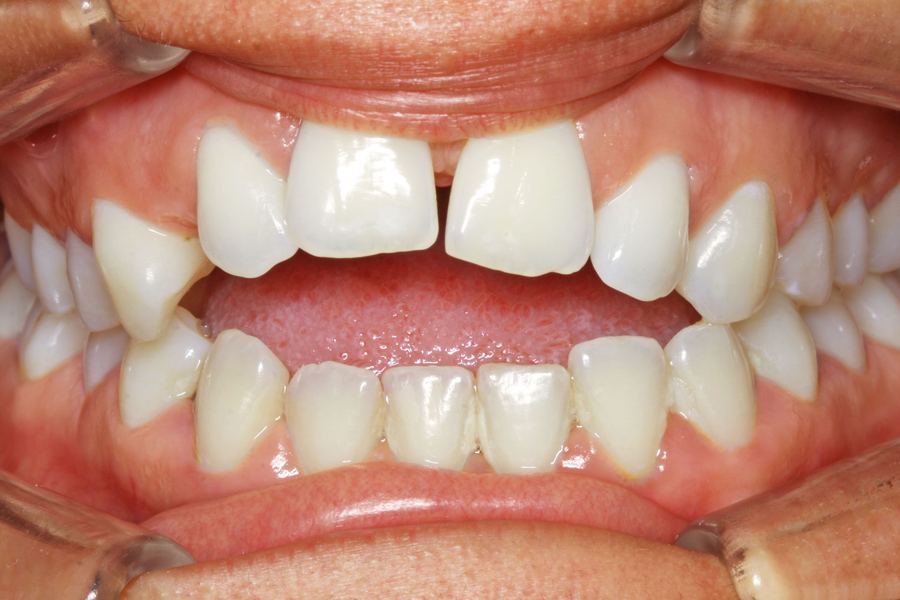
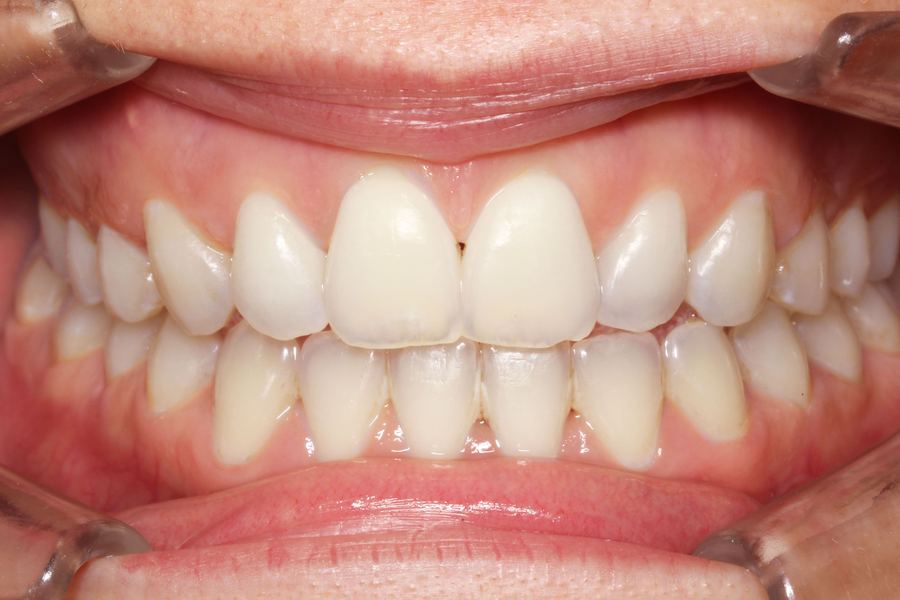
Spacing and crowding treated with lingual braces.
The Lingual by Issembert approach
Aesthetics
- Brackets behind the teeth, invisible when you smile.
- Stripping planned to a tenth of a millimetre to correct black triangles.
Stability
- Arches coordinated to prevent relapse.
- A bite designed for a long-lasting retainer.
- Double retention (wire + 2 safety retainers) included in the fee.
Efficiency
- Dr Issembert works with his own technician, whom he trained, and finalises every tooth position himself.
- 20+ years of lingual practice; several hundred patients treated each year.
Lingual-mixed: a more affordable option
Lingual-mixed treatment combines lingual brackets on the upper teeth with ceramic brackets and a white wire on the lower teeth. Because the lower teeth are mostly hidden by the lower lip when you smile, many patients choose this option. It costs less than full lingual treatment and is just as effective.
Which cases can be treated?
All cases can be treated with Lingual by Issembert: with or without extractions, with or without jaw surgery.
Treatment step by step
First consultation
Dr Issembert asks what you want to change, then makes a precise diagnosis. If he sees something you had not mentioned — for example a lower jaw set back — he explains it, and you decide whether you want it corrected.
Records appointment (about 30 minutes)
Panoramic and profile X-rays, photographs and impressions — often on the same day as the consultation.
Custom set-up
Brackets are positioned by hand on models of your teeth and each tooth movement is planned individually.
Bonding and follow-up
The braces are bonded behind your teeth; you then come for regular adjustments.
Retention
A bonded wire and two safety retainers secure the result.
Frequently asked questions
Are lingual braces really invisible?
Yes. The brackets and wires are bonded to the inner surface of the teeth, so they cannot be seen when you talk or smile.
How quickly will I see a difference?
Teeth are usually pre-aligned within 4 to 6 months. The rest of the treatment refines the alignment, closes residual spaces and coordinates the two arches.
What is lingual-mixed treatment?
Lingual brackets on the upper teeth and ceramic brackets with a white wire on the lower teeth, which are mostly hidden by the lower lip. It is less expensive than full lingual treatment and just as effective.
Can teenagers have lingual braces?
Yes. Lingual orthodontics is possible at any age and is chosen by many teenagers who want complete discretion.
Book a first consultation in Paris
44 avenue Marceau, Paris 8th · Monday–Saturday · Appointments usually available within one to two weeks.